
Gutters rarely decide a sale, but they show up in three places during one: the seller's disclosure form, the inspector's report, and the buyer's walk around the foundation after the first rain. Handling them before listing is cheaper than negotiating them under contract. This article goes through the Colorado Real Estate Commission's SPD19 form as it relates to gutters, roofs, hail and drainage, then gives sellers and buyers a short checklist. It is general information, not legal advice.
Colorado Springs Gutter Installation is a free quote service. We connect Colorado Springs-area homeowners with independent local gutter installation, guard and repair companies for free, no-obligation quotes. This article is general information, not legal advice.
What the SPD19 asks
The Colorado Real Estate Commission's Seller's Property Disclosure (Residential), form SPD19, was re-adopted August 5, 2025, with mandatory use from January 1, 2026. Its preamble sets the standard: if the seller has knowledge of an adverse material fact affecting the property or occupants, "it must be disclosed whether there is a specific item on this Disclosure or not." The items below are quoted from the earlier edition (SPD19-6-17); the 2026 edition reportedly rewords the roof section as "Roof leak; Damage to roof, and Damage to gutter or downspout," so read the current form from the Division of Real Estate rather than relying on item numbers here.
- Section A, Structural: item 4, "Damage due to hail, wind, fire, flood or other casualty"; item 5, "Cracks, heaving or settling problems."
- Section B, Roof: "If you know of any of the following problems EVER EXISTING check the 'Yes' column: 1 Roof leak 2 Damage to roof 3 Skylight problems 4 Gutter or downspout problems 5 Other roof problems." The section also asks about roof warranty, material and age.
- Section J, Flooding and Drainage: item 1, "Flooding or drainage."
- Section P, Other: item 2, "Written reports of any building, site, roofing, soils or engineering investigations or studies of the Property"; item 3, "Any property insurance claim submitted (whether paid or not)."
Read together, a sagging gutter, a hail claim, a wet basement corner and a soils report all have a box. The word "ever" in the roof section is the one sellers trip on: a gutter problem fixed five years ago is still a problem that existed.
Why so many El Paso County sellers check yes
Three documented hail catastrophes in eight seasons mean most roofs and gutters in the market have been claimed on, replaced or dented at least once. The July 28, 2016 storm produced $352.8 million in insurance losses from 84,500 claims (RMIIA), and just over 34,000 re-roof permits were issued in El Paso County that year. The June 13, 2018 pre-dawn storm over Fountain, Security-Widefield and southern Colorado Springs added $169 million and 26,000 claims. In 2023 PPRBD issued more than 17,000 re-roof permits, up 179 percent on 2022.
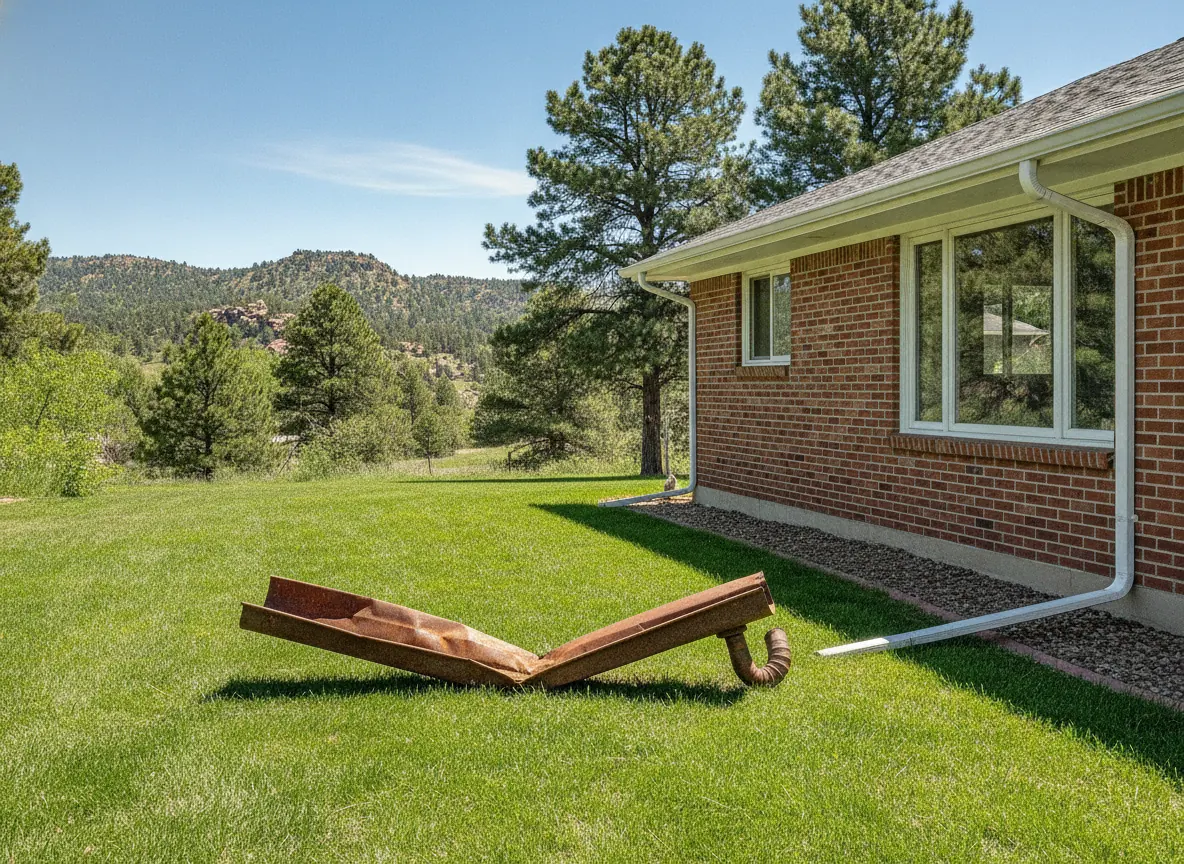
Drainage and heave have their own history. The Colorado Geological Survey calls expansive soil the state's most significant geologic hazard, maps steeply dipping expansive bedrock across northwest and southwest Colorado Springs, and says downspouts that discharge at the foundation are a common cause of damage; its guidance is discharge "no closer than 5 feet from the foundation" with a 5 percent slope in the first ten feet. A downspout that ends at the wall is how a Section A.5 "heaving or settling" answer gets created.
Sellers: what to check before you list
Walk the gutters after a storm
Look for runs that sag or hold water, seams that drip, overshoot marks on the siding, a trench in the mulch under the eave, and downspouts that dump next to the foundation. It goes on the form either way, so it is better to fix it first.
Fix the small things
HomeAdvisor (2026) puts gutter repair at $194–$643, about $400 on average, with a seam reseal from about $100 and downspout extensions at $2–$17 each. The gutter repair page lists what a visit covers; if the gutters are hail-flattened, see the replacement page and the cost guide.
Gather the paperwork
Section P asks for reports outright. Pull together the roofing contract (Colorado's roofing law, CRS 6-22-103, requires a written contract from roofing contractors on residential work), the PPRBD re-roof permit and the contractor's D-1 license number, the manufacturer's and installer's warranties, any insurance claim letters, and any soils or engineering reports you received when you bought.
Disclose and describe
A yes with a one-line explanation and a repair invoice reads very differently from a yes with nothing behind it. If unsure whether something qualifies, ask your broker or a real estate attorney.
Buyers: what to look at and ask for
- Read Sections A, B, J and P of the SPD19 before the inspection and ask for every document they mention.
- Check roof age and warranty, and whether the warranty transfers; ask for the hail claim history and the re-roof permit.
- Look at where every downspout ends. The 2021 IRC adopted through the 2023 Pikes Peak Regional Building Code calls for grade to fall at least 6 inches in the first 10 feet (R401.3; check PPRBD's amendments before citing it as local law), and the Colorado Geological Survey wants discharge at least 5 feet out.
- Above 7,000 feet (Black Forest at 7,369 ft, Woodland Park at 8,481 ft), ask whether the last re-roof included the ice barrier PPRBD requires.
- In the Hillside Overlay and other WUI areas, ask what the gutters are made of; the wildfire code article explains why.
Landlords and investors
If the house is a rental rather than a sale, Colorado's warranty of habitability still reaches the roof edge. CRS 38-12-505 deems a residential premises uninhabitable if it substantially lacks "waterproofing and weather protection of roof and exterior walls maintained in good working order," and CRS 38-12-503 obliges the landlord to maintain the premises as fit throughout the tenancy. Gutters are not named, but a failed gutter that soaks a wall is argued under those lines. Check the current statute or ask a tenant-rights attorney.
Keep the paperwork, whichever side you are on
Every SPD19 question that touches gutters is easier with a document behind it. When you hire a company for pre-sale gutter work, ask for proof of liability insurance and workers' comp, an itemized written quote, and the warranty terms in writing, and file them with the house records. Ask your insurer what your policy covers if a claim is involved.
Frequently asked questions
Do I have to disclose old gutter problems that were already fixed?
The roof section of the SPD19 asks whether you know of listed problems "ever existing," which on its face includes ones that were repaired, and the form's preamble says any adverse material fact must be disclosed whether or not a specific line covers it. The usual approach is to check yes, describe the problem and attach the repair paperwork. Read the current form and ask your broker or a real estate attorney; this is not legal advice.
Does a hail insurance claim have to be disclosed when selling in Colorado?
The SPD19's "Other" section asks about any property insurance claim submitted, whether paid or not, and the structural section asks about damage due to hail, wind, fire, flood or other casualty. Given the July 2016, June and August 2018 and 2023 hail seasons, many El Paso County sellers answer yes to both. Keep the claim letters, the roofing contract and the permit so a buyer can see what was done.
What should a buyer check on the gutters before closing?
Walk the house after rain if you can. Look for sagging runs, separated seams, staining on fascia or siding, a trench in the mulch under the eave, and downspouts that end at the foundation instead of five or more feet away. Ask for roof age, warranty papers, any hail claim records and the re-roof permit. Above 7,000 feet, ask whether the last re-roof included the ice barrier PPRBD requires.
How much does it cost to fix gutters before listing?
HomeAdvisor (2026) puts gutter repair at $194 to $643, about $400 on average, with a seam reseal from about $100. Downspout extensions run $2 to $17 each. If the gutters are hail-dented or past saving, seamless aluminum replacement runs $4 to $13 per foot depending on the source, roughly $1,200 to $4,200 for a 200-foot home. These are estimates, not quotes; ask for an itemized written quote.
Get a quote before the listing photos
A free, no-obligation quote request takes about a minute. Say you are preparing to sell and whether you want repair and replacement priced separately. We usually reply the same day. You can also call: Call (727) 300-6656.