
Ice dams are a different problem in Fountain than in Woodland Park. Down low, gutters sit nearly dry all winter. On the Palmer Divide and in Teller County the snow stays, the roof edge cycles through freeze and thaw for months, and a gutter packed with ice weighs more than its hangers were meant to carry. This guide covers the sourced snow figures, how an ice dam forms, the 7,000-foot ice-barrier rule for re-roofs, and what heat cable costs.
Colorado Springs Gutter Installation is a free quote service. We connect Colorado Springs-area homeowners with independent local gutter installation, guard and repair companies for free, no-obligation quotes. This article is general information, not legal advice.
How much snow each area actually gets
All of the figures below are NOAA 1991–2020 climate normals unless noted. At Colorado Springs Municipal Airport the normal is 32.5 inches of snow a year on 11.0 days with an inch or more, with 159.7 nights at or below 32°F. March (5.7 in.) and April (5.5 in.) are the snowiest months, and spring snow is the wet, heavy kind.
The NOAA Monument station tells a different story: 121.1 inches of snow, 22.53 inches of precipitation, 59.4 wet days and 34.5 days with an inch or more of snow, 3.7 times the airport's snowfall. March (24.2 in.) and April (23.7 in.) are again the biggest months. The town sits at 6,982 feet, Palmer Lake at 7,139 and Gleneagle at 6,870, on the Palmer Divide that rises about 2,000 feet from Fountain to Monument.
Black Forest (7,369 ft) has no NOAA snow normal of its own. The Black Forest 6WNW station records 19.60 inches of precipitation against 15.91 at the airport, and the Eastonville 2 NNW station at the forest's northeast corner records 101.7 inches of snow. Woodland Park (8,481 ft) has no NOAA 1991–2020 snow normal either; the nearest precipitation normal is Divide 4NW at 19.98 inches, and KOAA reports that Teller County sees a six-inch-plus snowstorm in May about once every two years.
How an ice dam forms, and what the gutter has to do with it
An ice dam is a building-science problem before it is a gutter problem. Heat escaping through the attic warms the roof deck, snow melts from underneath, and the meltwater runs down to the eave, which hangs past the heated wall and stays cold. There it refreezes into a ridge. Water backing up behind the ridge works under the shingles, which is why the code answer is an ice barrier under the roofing, not anything attached to the fascia.
The gutter sits exactly where that ridge grows. A 5-inch K-style trough full of ice becomes a heavy bar hanging on hangers spaced for water, not ice: pulled fasteners, a sagging run that no longer drains, split seams, and a downspout frozen solid to the ground. Installers on the Palmer Divide tend to recommend closer hanger spacing and heavier-gauge metal. Ask for hanger spacing in writing on any quote above 7,000 feet; the seamless gutter installation page lists the other items an itemized quote should show.
The 7,000-foot ice-barrier rule
Stand-alone gutter work has no permit category at the Pikes Peak Regional Building Department, so a gutter-only job generally needs no PPRBD permit or license; confirm with PPRBD for your project. The rules change the moment gutters are part of a re-roof. PPRBD's Re-roof Guidelines (Rev. 03/05/2024) state that "properties that are above 7,000 ft. elevation require an ice barrier" running from the eave's edge to a point at least 24 inches inside the exterior wall line. The same handout requires drip edge at eaves and rakes on shingle roofs (2021 IRC Section 905.2.8.5), a PPRBD permit for any repair or replacement over 100 square feet, and a Class A roof covering on one- and two-family dwellings in the City of Colorado Springs.
Who may do that work is also spelled out: contracting or performing a re-roof over 100 square feet without a license is a code violation unless you own the home and it is your primary residence. So if a roofing company is replacing your roof and gutters together in Black Forest or Woodland Park, ask for the D-1 roofing license number, the permit number, and confirmation that the ice barrier is in the scope. Woodland Park's building services run through PPRBD; unincorporated Teller County (Divide, Florissant) uses the Teller County Building Division. The permit and licensing guide goes through the whole chain.
Heat cable types and what they cost
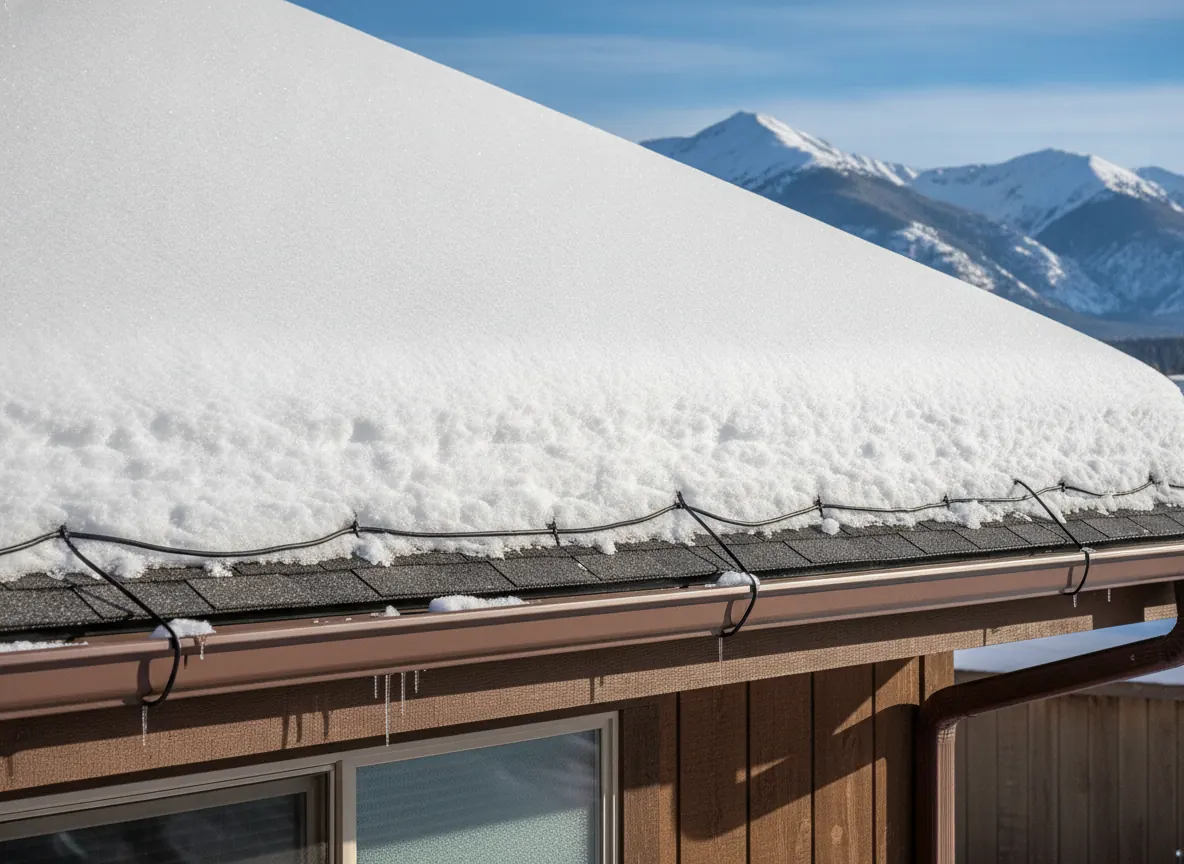
Heat cable does not prevent ice dams; it keeps a drainage path open through them so meltwater can leave the roof. The two types are self-regulating cable, which changes its output with the surrounding temperature and can be cut to length, and constant-wattage cable, which puts out the same heat whenever it is switched on. HomeAdvisor (2026) prices self-regulating cable at $2–$5 per foot and constant-wattage at $1–$3 per foot for the cable alone. Installed, a heat cable or ice-dam system typically runs $900–$1,800, with small jobs from about $500, plus $40–$200 or more a month in electricity while it runs. These are typical ranges from HomeAdvisor (2026), Fixr (2025) and a Colorado Springs cost directory (2025), estimates, not quotes.
A standard layout zigzags the cable along the lower roof edge, runs it the length of the gutter, and drops a loop down each downspout. Electrical work in Colorado is regulated by the state (DORA), so ask who is doing the circuit and whether the control is a manual switch, a thermostat or a snow sensor. The heat tape and ice dam page explains how a quote is usually structured.
Guards, winter installs and a timing note
Gutter guards do not cause ice dams, but ice forms on top of a guard just as it does in an open trough. If you want guards and cable, say so up front so the installer can route the cable over or under the mesh; the gutter guards page compares the types.
Can gutters be installed in winter? At the airport, December through February bring only 0.23 to 0.37 inches of precipitation a month, so dry working days are common at lower elevations; the constraints are a clear roof edge, safe footing and the sealant's rated temperature. Above 7,000 feet the window is narrower.
Frequently asked questions
Does heat tape in gutters work?
Heat cable keeps a melt channel open through the ice in a gutter and downspout so water can leave the roof edge instead of freezing in place. It does not stop snow from melting on a warm roof deck, which is the cause of an ice dam, so it is a drainage aid, not a cure. Self-regulating cable is the type most often recommended for gutters because it adjusts its output to the temperature around it.
Do gutter guards cause ice dams?
No. Ice dams form when heat escaping the house melts snow on the roof and the meltwater refreezes at the cold eave. Guards do not change that. Ice can form on top of a guard and look worse than an open gutter, and a guard can make it harder to lay heat cable inside the trough, so tell the installer you want both and ask how the cable will be routed.
Can gutters be installed in winter in Colorado Springs?
Often, yes. NOAA's 1991 to 2020 normals put December, January and February at 0.23 to 0.37 inches of precipitation each, the driest months at the airport. The limits are a roof edge clear of snow and ice, safe footing, and the temperature range the sealant is rated for. Ask the installer what minimum temperature they work in and how they protect fresh seams.
When should heat tape be turned on and off?
Most installers suggest energising the cable before a storm when snow will sit on the roof and temperatures will stay below freezing, and switching it off once the roof edge and downspouts are clear. Self-regulating cable can be left on a thermostat or snow sensor so it runs only when needed. HomeAdvisor (2026) puts the added electricity at about $40 to $200 or more per month while it runs.
Get quotes for heat cable or snow-country gutters
If you are in Monument, Black Forest, Gleneagle, Palmer Lake or Woodland Park and want heat cable, heavier gutters or a replacement before the next March storm, a free, no-obligation quote request takes about a minute. Mention your elevation, roof type and whether a re-roof is involved. We usually reply the same day. You can also call: Call (727) 300-6656. See the Monument and Woodland Park area pages for local notes.